
Every year, the Land Trust works with other local organizations on a long-term patnership to reintroduce spring Chinook salmon and summer steelhead in the upper Deschutes River region. This year, from March through May, we are aiding in the acclimation and release of juvenile steelhead into Whychus Creek near Sisters and McKay Creek near Prineville.
Acclimation is when smolts (fish that are one year old) are contained in water from the stream or river they would naturally return to for spawning. Smolts are particularly sensitive to the smell of the water from their home creek and imprint, or store the smell in their brain, to help them find their way back to the same area as an adult.
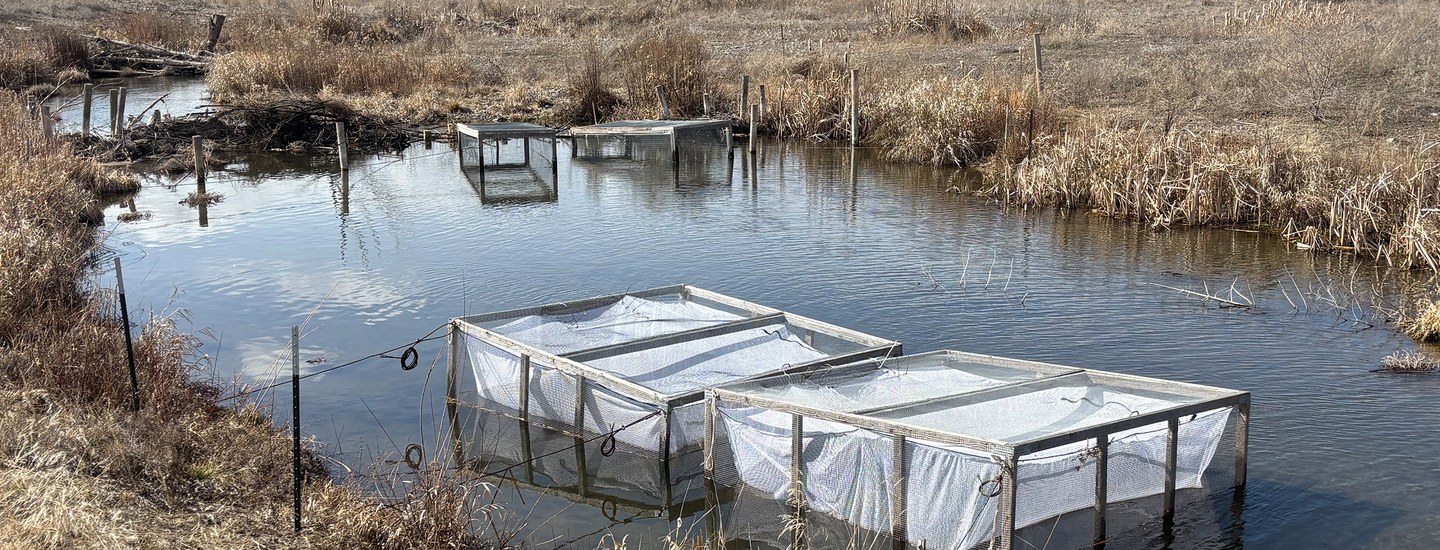
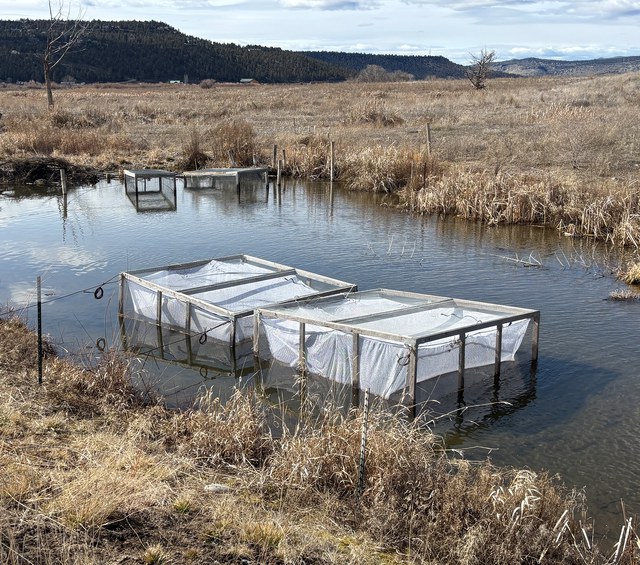
At Camp Polk Meadow Preserve along Whychus Creek, a large acclimation tank is used to acclimate summer steelhead smolts before their journey downriver. Meanwhile, in McKay Creek at Ochoco Preserve, between 25,000-30,000 steelhead are being acclimated this spring in pens called live cars.
Once the smolts have been acclimated at Camp Polk Meadow Preserve, a portion have been or will be released at the Preserve, directly into Whychus Creek. Meanwhile, other smolts being acclimated there will be transferred from the acclimation tank to a stress relief pond at Round Butte Dam on Lake Billy Chinook. There, the fish will de-stress from their trip before being released downstream of the dam in the evening. The hope is that by releasing them downstream, the fish will already have an obstacle removed from their journey to the Pacific Ocean. A similar approach is being taken at Ochoco Preserve, where some smolts are being released directly into McKay Creek after acclimation, while others are being transferred to the stress relief pond at Round Butte Dam.
In order to track the smolts once they've been released, a PIT (passive integrated transponder) tag is inserted into some of the fish. The PIT tag is somewhat similar to a microchip for your pet. PIT tag monitoring stations, located at certain points along fish migration routes, record the unique tag number as the fish passes by. In this way, we’re able to monitor the fish’s progress when they head out to the ocean, then track them again upon their return to spawn. We look forward to tracking their progress and celebrating the fish that return to the waters of Whychus Creek and McKay Creek!
Meanwhile, we have other exciting reintroduction news to share! Over the last several weeks, teams have been conducting redd (fish nest) surveys to count redds in our local waters. At Ochoco Preserve, 9 steelhead redds and 10 redband redds have been counted in McKay Creek, with another 6 steelhead redds and 1 redband redd spotted in the Crooked River section on the Preserve. Fish are still actively building redds at Ochoco Preserve, but it is starting to slow down. This is just one sign of how the Ochoco Preserve Project is already starting to provide more habitat for fish.
On Whychus Creek, spawning will continue throughout the month. This year is already the highest documented steelhead spawning in the system since reintroduction efforts began! Redd surveys have occurred at Land Trust Preserves, with current counts of 3 steelhead redds at Rimrock Ranch, 1 steelhead redd at Whychus Canyon Preserve, 1 steelhead redd at Camp Polk Meadow Preserve, and 1 steelhead redd at Willow Springs Preserve.
In other fish news, in the 1990s a goal was set for 955 steelhead to return upstream each year. As of the end of February, more than 860 adult steelhead have been released above the dams to spawn, which is the second year in a row with numbers close to the goal. This is an encouraging sign of the slow but steady progress being made toward fish reintroduction success, and highlights the importance of ongoing conservation and restoration efforts.
These successes wouldn't be possible without our partners in this work—Oregon Department of Fish and Wildlife, Portland General Electric, and the Confederated Tribes of Warm Springs; also to our longstanding collaborators in The Deschutes Partnership.